
Find tractor weight references, mounting measurements, and the details needed for a product inquiry. North State Sales supplies dealers and OEMs wholesale. Equipment owners and operators can use these resources to prepare questions for their equipment dealer.
Find a product by part number
Search North State Sales part numbers, listed OEM references and product names across our product directory.
Prepare a fitment inquiry
A useful inquiry identifies the machine, the part, and the mounting arrangement. A matching color or nominal weight does not establish compatibility.
- Identify the equipment. Record the make, model, and relevant serial information. For loader work, include the loader and attachment models.
- Describe the job and existing setup. Note the work being performed, current weights or other ballast, wheel configuration, and the applicable manual's ballast instructions.
- Identify the weight and bracket. Include any North State Sales part number, manufacturer reference, or visible casting number. State which number came from which source.
- Record the mounting details. Use the illustrated guide below for wheel-weight hole measurements. Include clear photos, measured dimensions and units, wheel or bracket details, and any known clearance constraints.
- Confirm the complete installation. Establish the required hardware, retention method, permitted quantity, and any unresolved fitment details before ordering or installing the weights.
Dealers can contact North State Sales for product information and use the mounting hardware directory when a weight or bracket number is known. Equipment owners should take the same information to their equipment dealer.
Wheel weight measurement guide
Use the illustrated guide to identify the mounting-hole arrangement and record the indicated center-to-center measurements. Count and measure the weight-mounting holes shown in the guide; record the measurement units with your results. Pair those measurements with the wheel details, part information, and applicable instructions when checking fitment.
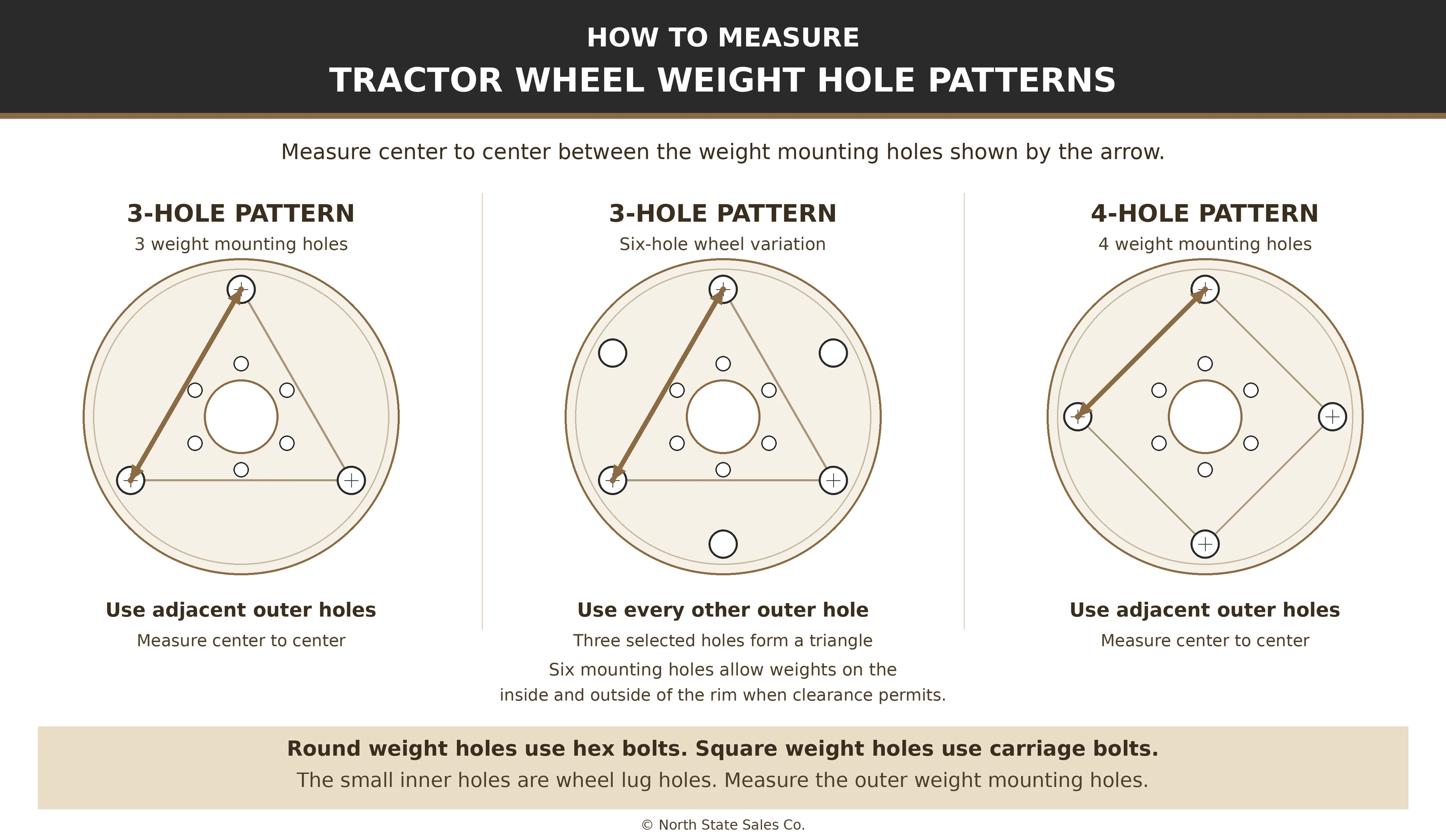
Open full-size measurement guide (opens in a new tab).
Loader ballast and balance guide
Explore how ballast location and leverage affect tractor balance and front and rear tire loading. The illustrated examples describe a stationary balance model; they do not increase manufacturer ratings or determine a safe working load.
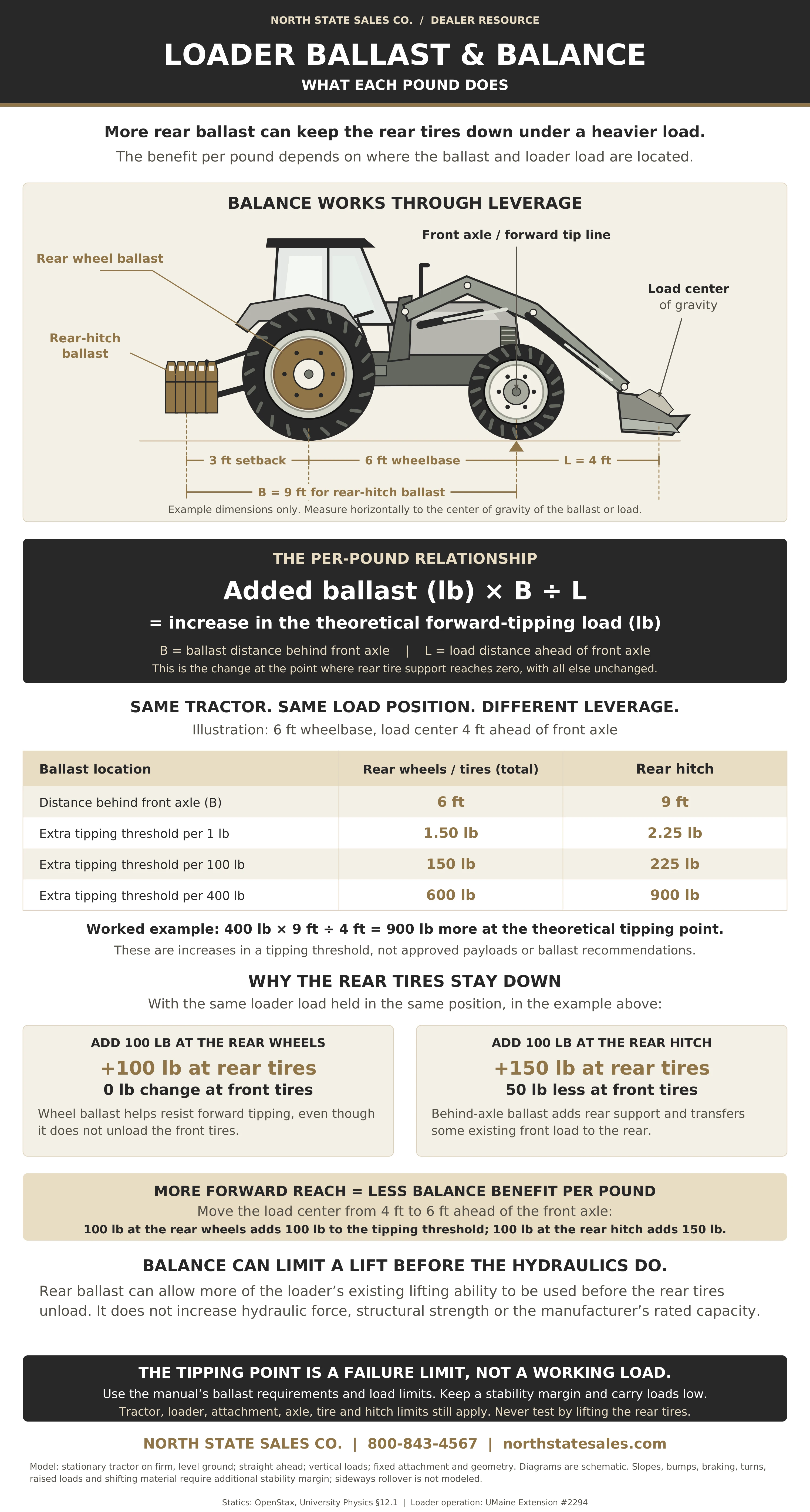
Open full-size loader ballast guide (opens in a new tab).
Read the loader ballast guide in text
This text explains the original graphic above. Its example assumes a stationary tractor on firm, level ground, straight ahead, with vertical loads and fixed geometry. It models front and rear ground support; it does not assess sideways rollover, movement, slopes, bumps, braking, raised-load stability or component strength.
What each pound changes
Added ballast in pounds × B ÷ L = increase in the theoretical static forward-tipping load in pounds.
B is the horizontal distance from the front axle to the ballast's center of gravity behind it. L is the horizontal distance from the front axle to the loader load's center of gravity ahead of it. Use matching distance units and a positive L. This relationship follows from balancing moments about the front support line.
The threshold is where rear ground support reaches zero, with everything else unchanged. It is a failure boundary, not a working load. The ratio changes with the geometry.
The graphic's example
The wheelbase is 6 ft and the load center is 4 ft ahead of the front axle. Rear-wheel ballast is 6 ft behind that axle; rear-hitch ballast is 9 ft behind it, or 3 ft behind the rear axle.
| Added ballast | At rear wheels | At rear hitch |
|---|---|---|
| 1 lb | 1.50 lb | 2.25 lb |
| 100 lb | 150 lb | 225 lb |
| 400 lb | 600 lb | 900 lb |
For the rear-hitch example: 400 lb × 9 ft ÷ 4 ft = 900 lb more at the theoretical tipping threshold. This is not an approved additional payload.
With the same payload held in the same position
- Add 100 lb at the rear wheels: rear ground support increases 100 lb; front ground support changes 0 lb.
- Add 100 lb at the rear hitch: rear ground support increases 150 lb; front ground support decreases 50 lb.
These are combined tire-to-ground forces at each axle line, not axle-component stresses. Hitch ballast transfers some existing front support rearward. Rear-wheel ballast still resists forward tipping without unloading the front tires.
If the load center moves to 6 ft ahead, 100 lb of ballast increases the theoretical threshold by 100 lb at the rear wheels or 150 lb at the rear hitch.
Ballast does not increase hydraulic force or manufacturer ratings. Tractor, loader, attachment, axle, tire and hitch limits still apply. The operator's manual controls ballast and load limits. Never test the threshold by lifting the rear tires.
References: OpenStax: static equilibrium; University of Maine Extension: front-end loader safety.
Dealer and wholesale help
North State Sales sells wholesale to qualified business accounts and does not sell retail or directly to consumers. Equipment owners and operators should purchase through an appropriate dealer or distributor.
- New dealers: apply for a wholesale account.
- Existing dealers: sign in to access dealer pricing and ordering.
- Product and OEM inquiries: contact North State Sales with the equipment and part information available.